
The year is 2026, and I have finally carved my name into the Forbidden Lands. Monster Hunter Wilds has consumed my every waking moment for weeks, and I’ve learned one immutable truth: size is not just a number—it’s a crushing, suffocating reality. The developers at Capcom built on the legacy of Monster Hunter World and flooded these wilds with creatures that don’t just fight you; they overwrite the entire horizon. I still remember the first time I glimpsed the official artwork, the same image that now hangs above my weapon rack. It was a promise of both wonder and terror.
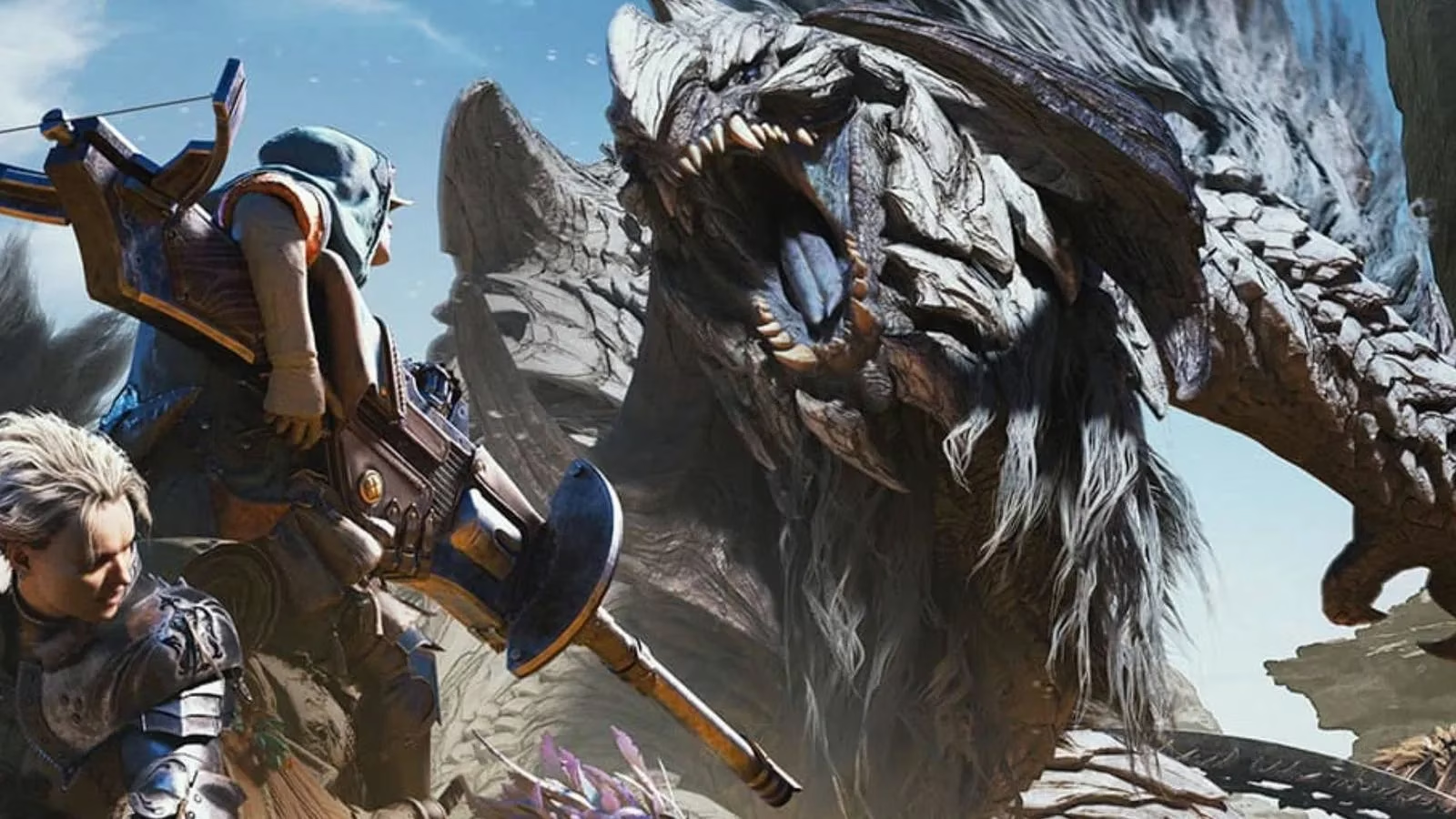
My journey began with Arkveld, the ghost who haunts the story’s second half. Though it’s technically one of the smaller Large Monsters, its presence feels like a lighthouse made of regret. The white-feathered wyvern moves with a sorrowful elegance, its chain-like appendages dragging behind it like living manacles that moan with every step. When Arkveld leeches elemental energy from its prey, those tendrils coil and pulse as if siphoning the very memory of life. I learned the hard way that underestimating a creature because it doesn’t blot out the sun is a fool’s errand. Arkveld’s aggression is a cold, calculated blade.
Next came the nightmare I thought I’d left in older games: Gore Magala. This jet-black Demi Elder arrived in the Iceshard Cliffs like spilled ink made of spite. Its wingspan is vast, but what truly unnerves me is the way the Frenzy virus spreads from its body—a contagion that twists beasts into rabid caricatures of themselves. Facing Gore Magala felt like stepping into a warped mirror where every reflection wanted me dead. I watched a normally docile herbivore turn on me with foam-flecked rage, all because the black wyvern’s mere presence rewrites the nature of things. Gore Magala isn’t large enough to crush a village in one step, but its influence makes the whole ecosystem feel like a tightening noose.
The Oilwell Basin taught me a different flavor of dread when I descended into its tar-choked depths and met Nu Udra. The legend of the Black Flame is not a fireside tale; it’s a creature that seems to have crawled out of a Lovecraftian nightmare. Its upper torso is eerily slender, almost humanoid in silhouette, but the mass of tentacles that writhe beneath it are like sentient roots searching for pain. Nu Udra’s attack pattern is a chaotic dance—a puppeteer tangled in its own strings—twirling, slamming, and smothering everything within reach. Fire blossoms from its body in spiraling arcs, and the lava itself becomes its ally. I emerged from that fight smelling of sulfur and humility.
Rey Dau was the first true storm I had to weather. In the Windward Plains, the golden wyvern is less a monster and more a weather system with teeth. Its wings are reinforced with barbs that hum with static before each lightning strike, and its roar splits the sky like a fault line. This is the skill check that separates the hopeful from the broken. I remember strafing around it, watching its scales gleam under gathering clouds, and thinking that Rey Dau was a wandering cathedral of destruction—every bolt a sermon that turned the ground into a pyre. Veteran hunters talk about it with grudging respect, and now I understand why.
The end of the story brought me face-to-construct with Zoh Shia, the guardian of ancient Wyveria. Awakened by my own curiosity, this human-made monstrosity rose from its slumber drenched in white, its form shedding layers of unnatural skin as I chipped away at its defenses. Zoh Shia’s size is not organic; it’s a monument to forgotten ambition. Every attack felt like the sky collapsing outward from its core. Although its exact statistics remain veiled in mystery, the visual spectacle alone convinced me that I was fighting a cathedral that had learned to hate. It was the kind of battle that makes you grateful for the silent loading screen afterward.
If Zoh Shia was a cathedral, then Gravios is a mountain that learned to walk. I first encountered the behemoth in the Oilwell Basin, and my initial reaction was a string of words I can’t repeat. Its adamantine scales are so dense that most weapons just shrug off their own impact, and the combustion breath it exhales is a jet of pure, unapologetic calamity. I circled Gravios for what felt like hours, looking for a weak point the way you’d search for a crack in a fortress wall. The ground shook with its every step, and I realized that some monsters aren’t just obstacles—they are the environment reimagined as an enemy.
Then came the deluge, and with it, Uth Duna. The aquatic leviathan rose from the Scarlet Forest’s waters like a tidal wave given flesh. Its sheer mass is a weapon; the fins that flare from its head and limbs make it look like a warped king of the deep. When Uth Duna slams its body into the water, it doesn’t create waves—it creates gravity surges that yank you off your feet and into its waiting maw. I felt like a leaf caught in an angry tide, and the memory of being crushed under its bulk still visits me when I close my eyes. Fighting Uth Duna isn’t a duel; it’s a negotiation with drowning.
Finally, I reached the Iceshard Cliffs and witnessed Jin Dahaad carving its migration through the world like a snowbound leviathan breathing stillness. Modeled after the sinuous dragons of eastern myth, Jin Dahaad is the largest living creature I have ever seen in any Monster Hunter title. Its movement is a slow-motion avalanche, each step freezing the air itself into brittle shards. I stood on a ledge, weapon trembling, watching this colossus trample the landscape with serene indifference. It didn’t roar at me; it simply existed with a weight that made my very bones feel insignificant. As of 2026, Jin Dahaad remains the undisputed king of size, and I can only hope that Capcom has even larger nightmares waiting in the wings.
From the chain-whips of Arkveld to the frozen cataclysm of Jin Dahaad, every hunt has etched a lesson into my scar tissue: in Monster Hunter Wilds, the biggest beasts don’t just test your skill—they redefine your understanding of scale. I am a hunter, and I am small. And I wouldn’t have it any other way.