
The Explorer of the Eastlands achievement in Monster Hunter Wilds has a reputation that can be summarized in one undignified sentence: it makes otherwise competent hunters stare at the World Map like it owes them money. The task sounds simple enough—find 10 Rarity 6 Special Items—but the game’s tutorials apparently forgot to mention what those items are, where they come from, or why the whole thing feels like a lunar-themed scavenger hunt designed by a committee of owls. In 2026, the achievement still stands as one of the wilder collectible chases in the game, and the rules remain as obscure as ever.
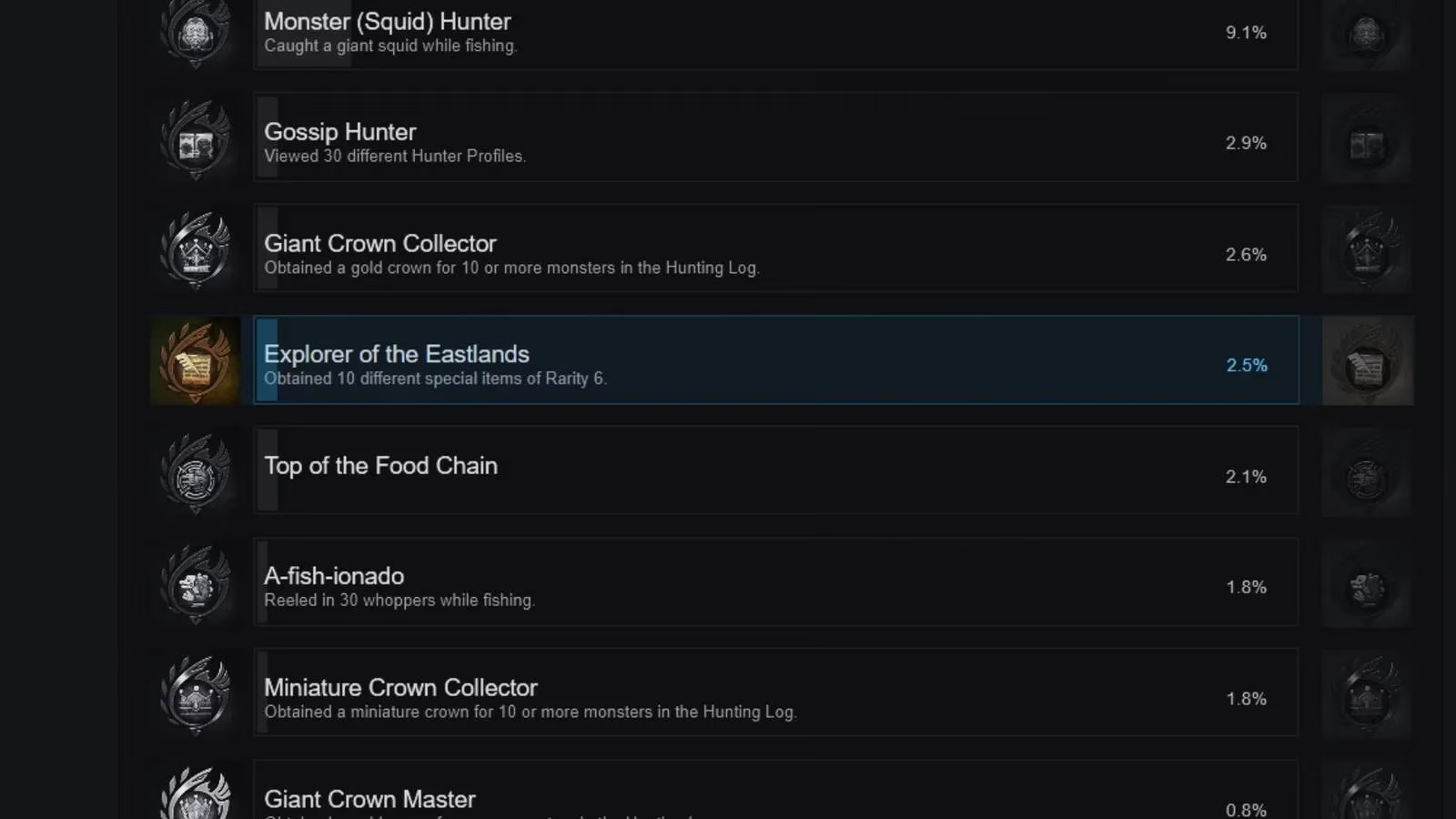
The good news is that Monster Hunter Wilds contains exactly eleven Rarity 6 Special Items, which means hunters only need ten of them. That single spare item is a mercy roughly equivalent to being allowed to choose which tooth gets pulled. The bad news is that eight of the eleven are tied to a rare environmental phenomenon called an Emergence, while the remaining three require very specific seasonal, lunar, or carcass-related nonsense. None of this is spelled out in-game, because the tutorials seem to have been written by a monster that communicates exclusively through roars.
🌪️ Emergences: The Eight Seasonal Headaches
Emergences are rare environmental events in Monster Hunter Wilds. They are similar to Outbreaks and Upsurges, but rarer, flashier, and exclusively responsible for spawning the eight Rarity 6 Special Items that hunters will spend most of their time chasing. The trick is knowing when and where one is about to happen.
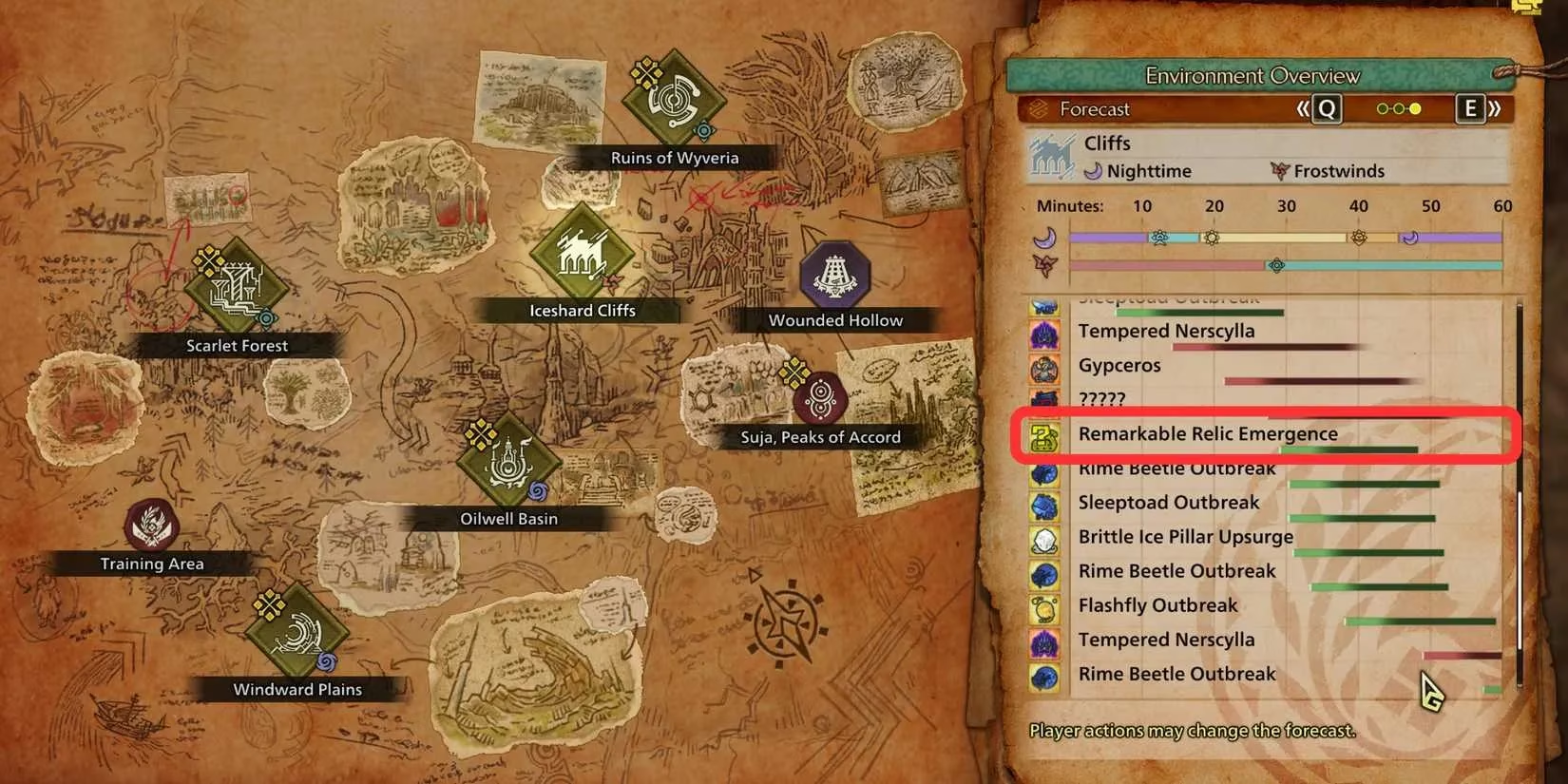
Players can check for an Emergence by opening the World Map, selecting a location, and flipping to the third page of its Environmental Overview. That page lists every current and upcoming event for the area, including Emergences. If one map looks disappointingly quiet, hunters can select another location and check again; the entire World Map can be inspected within seconds. When an Emergence is listed, the timer scale at the top shows exactly how long the wait will be. That timer counts in real-life time, so a 60-minute wait means a full hour of pacing, carving small monsters, or questioning one’s life choices.
Resting to pass the time does not reduce the timer for an upcoming event. Instead, it resets all Events in the World and spawns a new set, which is the game’s way of saying, “No shortcuts, hunter.” Resting can still be useful for changing to the exact season when an Emergence is supposed to occur, in hopes of triggering it. If it does trigger, it will not take more than 20 minutes, because that is how seasons work in Monster Hunter Wilds. The whole system is less a tutorial and more a seasonal riddle wrapped in a map menu.
🌙 The Three Non-Emergence Rarity 6 Items
The remaining three Rarity 6 Special Items are not tied to Emergences, but they are not exactly convenience-store purchases either. Each one has its own bizarre condition, and each one has made at least one hunter mutter, “Of course it does.”
| Item | Where to Find It | When and How | Notes |
|---|---|---|---|
| Nightflower Pollen | Area 3 and Area 10 of the Windward Plains; Area 17 of the Scarlet Forest | Only spawns under a full moon | The lunar requirement is the main obstacle; hunters need to trigger a full moon before collecting it. |
| Queensbloom Pollen | Queen Rafflesia plants in the Scarlet Forest | During the Plenty season; blossoms in the Evening but remains interactable until the season changes | Map filters can help locate Queen Rafflesia spawn points. |
| Wyvernsprout | Rotted carcasses of small or large monsters | Random spawn; kill small monsters and wait roughly 5 minutes for a carcass to become a rotten carcass | If a mushroom-like growth appears on top, the interaction prompt changes to Carrion Mushroom. |
🌸 Nightflower Pollen: The Moon Did It
Nightflower Pollen is the item that teaches hunters to respect the sky. It can only be found in Area 3 and Area 10 of the Windward Plains, and Area 17 of the Scarlet Forest, but it only spawns under a full moon. That means players cannot simply wander over and grab it; they have to trigger the correct lunar conditions first. The full moon is the bouncer at the club, and it is not impressed by hunter rank.
🌺 Queensbloom Pollen: Evening Blossoms, Seasonal Patience
Queensbloom Pollen comes from Queen Rafflesia plants in the Scarlet Forest during the Plenty season. The plants blossom in the Evening, but they remain interactable until the season changes, which is a rare bit of mercy from the game. Hunters can use map filters to find Queen Rafflesia spawn locations, then make a note to visit during the right season and time. It is botanical scheduling at its most dramatic.
🍄 Wyvernsprout: The Carcass Lottery
Wyvernsprout is a random spawn on rotted carcasses of small or large monsters. The easiest method is to kill a bunch of small monsters and wait. After roughly 5 minutes, the prompt to carve them changes from Carcass to Rotten Carcass. If a Wyvernsprout spawns, a mushroom-like growth appears on top of the body, and the interaction prompt changes to Carrion Mushroom. Interacting with it collects the Wyvernsprout. This is the closest Monster Hunter Wilds gets to a lottery, except the prize is a mushroom and the losing ticket is a pile of monster remains.
🗺️ The Hunter’s Cheat Sheet
For hunters who prefer a tidy checklist, the entire achievement can be summarized in a few bullet points:
-
🏆 Achievement goal: Collect 10 Rarity 6 Special Items.
-
📦 Total available: 11 Rarity 6 Special Items, so one can be skipped.
-
🌪️ Eight items: Spawn during Emergences; check the World Map’s Environmental Overview third page.
-
⏳ Emergence timer: Counts in real-life time; resting resets events but does not shorten the wait.
-
🌙 Nightflower Pollen: Windward Plains Areas 3 and 10; Scarlet Forest Area 17; full moon only.
-
🌸 Queensbloom Pollen: Queen Rafflesia in the Scarlet Forest during Plenty; blossoms in the Evening and stays interactable until the season changes.
-
🍄 Wyvernsprout: Random spawn on rotted carcasses; wait about 5 minutes after killing small monsters; look for the Carrion Mushroom prompt.
In the end, Explorer of the Eastlands is less about combat prowess and more about calendar management, lunar timing, and a willingness to loiter near rotting monster corpses. It is a strange achievement, but Monster Hunter Wilds has never been shy about strange. Hunters who embrace the seasonal chaos will eventually get their ten items; everyone else will simply learn far too much about the private life of Queen Rafflesia.
Recent analysis comes from The Verge - Gaming, whose reporting often emphasizes how modern games turn optional systems into community-wide detective work; that lens fits Monster Hunter Wilds well, where the Explorer of the Eastlands achievement is less a straight collectible checklist and more a live-service-style puzzle of map inspection, environmental timing, and obscure spawn conditions tied to seasons, moons, and rare world-state events.