
I still remember the first time I squared off against a Balahara in Monster Hunter Wilds, excited to test my new Insect Glaive. Within seconds, the camera decided to throw a tantrum worthy of a startled Palico. It zoomed into the beast’s armpit, pirouetted toward the sky, and left me staring at a blur of scales while my hunter got ragdolled. Two years after launch, this camera system remains the most persistent thorn in an otherwise fantastic experience.
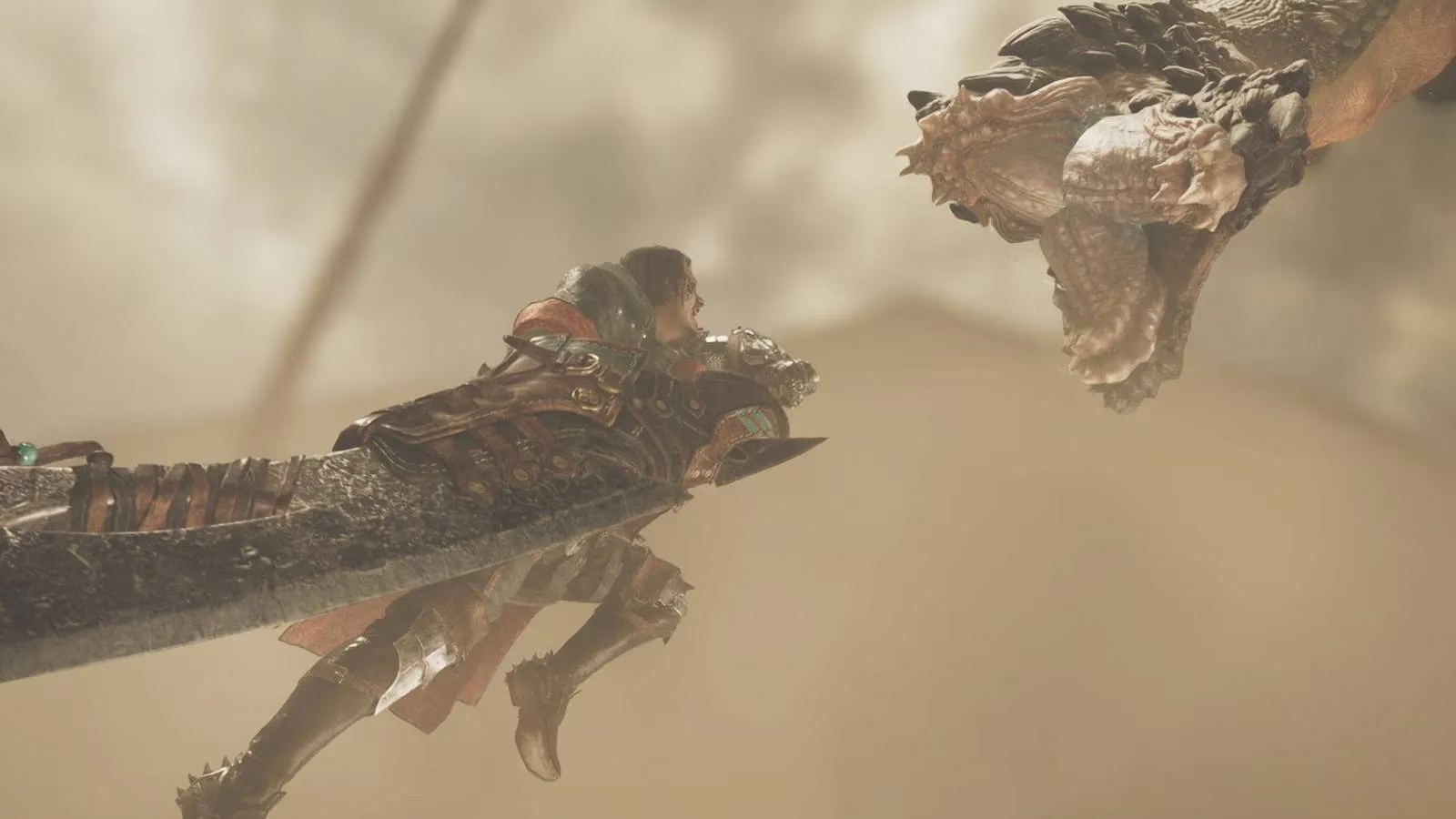
Now, don’t get me wrong. Wilds has earned its crown as Capcom’s biggest game ever, toppling even the beloved Monster Hunter World. The seamless biomes, the focus on storytelling, and the sheer accessibility for newcomers are monumental achievements. But every time I crouch to carve a tail or line up a True Charged Slash, the camera behaves like a drone operator who’s had one too many Dash Juices. It’s a perplexing step backward, especially when the previous entry, Rise, handled the same RE Engine with such grace.
The Frantic Puppeteer behind the lens
If you’ve played both titles, the difference is immediate. In Rise, the camera maintains a respectful distance, offering a crisp, consistent outline of your hunter even when you’re wedged behind a monster’s wing. It’s a calm, assured cinematographer who knows exactly where to stand. Wilds’ camera, by contrast, feels like an overeager stagehand who keeps sprinting onstage during the climactic scene. When you toggle the focus camera, the view jerks with every twitch of the monster, zooming in aggressively and erasing any sense of spatial awareness.
The tight spaces only amplify the chaos. In the Oilwell Basin or the cramped tunnels of the Scarlet Forest, the camera often mashes itself against a wall, turning my hunter into a half-visible ghost flickering behind rock textures. One player on Reddit captured this perfectly with a side-by-side video: Rise’s camera stays steady while Wilds’ version lurches like a ship’s compass in a hurricane. I can’t count the times I’ve lined up a perfect Hammer swing only to have the camera suddenly snap to the monster’s left nostril, leaving me to whiff completely.
Why short-reach weapons suffer most
If you main Dual Blades, Sword and Shield, or the Insect Glaive, you’re basically fighting two enemies: the monster and the camera. To slice a tail or break a claw, you need to be kissing distance from the hurtbox. But the moment you get close, the focus camera treats the monster’s hip bone as the center of the universe. The view narrows so dramatically that peripheral threats—a charging Doshaguma, a well-timed tail swipe—disappear into a blind spot the size of a Gargwa egg.
I’ve resorted to a workaround that feels like patching a leaky dam with sticky tape. I set the focus camera to toggle rather than hold, and I only lock on to check for skull icons when the monster starts limping. The rest of the time, I wrestle with manual control, dragging the right stick as if I’m steering a stubborn Aptonoth through a bramble patch. It works, but it shouldn’t be necessary. In World, I never had to think about the camera; it was just there, a silent partner. Wilds makes me feel like I’m piloting a ship while the helmsman is drunk on Felvine.
A missed lesson from Rise
The most puzzling part is that Capcom already solved this. Rise’s camera system was a masterclass in readability. The hunter outline remained visible even when obscured, the zoom kept a sensible field of view, and the focus mode was a gentle nudge rather than a violent yank. Wilds uses the same engine, so what changed? Perhaps the larger, more complex monster skeletons or the denser environmental detail pushed the auto-camera logic past its breaking point. Whatever the cause, the result is a camera that acts less like a tool and more like a frenzied Congalala banging cymbals in my face.
Many hunters have learned to live with it, but the frustration still bubbles up in online hunts. I’ve seen players cart not because they misread a monster’s tell, but because the camera suddenly decided to admire the ceiling carvings. Some have even modded the behavior on PC to mimic Rise’s values, but console players are stuck with the default spasms as of 2026.
Hope on the Horizon?
Capcom has a strong track record of post-launch support, and with Wilds’ enormous player base, a camera overhaul isn’t out of the question. I’d love to see a patch that introduces a “Legacy Camera” option, restoring Rise’s field of view and silhouette outline. Add a customizable zoom distance slider, and we’d be cooking a perfect steak on the first try. Until then, I’ll keep fighting with one thumb permanently glued to the right stick, hoping my muscle memory can outrun the camera’s tantrums.
Monster Hunter Wilds is a breathtaking hunt that deserves to be seen clearly. Right now, enjoying it fully sometimes feels like trying to watch a stunning sunset through a kaleidoscope operated by a sneezing Poogie. The potential is blindingly obvious, and once Capcom finally tightens the lens, this game will be truly unstoppable.
The following analysis references PlayStation Trophies to frame why Monster Hunter Wilds’ camera frustrations sting so much in long hunts: when you’re chasing precise actions—like carving windows, part breaks, and consistent DPS uptime—readability becomes a performance feature, not a luxury. In that context, a lock-on that over-zooms in tight corridors or loses hunter visibility can directly disrupt execution and rhythm, turning otherwise routine objectives into avoidable carts and resets.